9th Class English - Chapter 3 Road Safety Week All Question With Answer
↓ Question & Answer ↓
Question 1. What is the first paragraph about?
(ପ୍ରଥମ ଅନୁଚ୍ଛେଦଟି କେଉଁ ବିଷୟରେ ?)
Answer:
The first paragraph is about the importance of road safety. It also deals with the causes of the road accidents and the steps and measures to be followed by the road users to check the dreadful accidents.
Question 2. What is road safety? What does it involve?
(ସଡ଼କ ନିରାପତ୍ତା କ’ଣ ? ଏହା କାହା ସହ ଜଡ଼ିତ। ସଂମ୍ପୃକ୍ତ ?)
Answer:
Road safety means the safety of people from roadside injuries and deaths. It involves various methods and steps which must be followed by the road users to prevent serious injuries and deaths due to road accidents.
Question 3. What is the finding of the World Health Organisation?
(ବିଶ୍ଵ ସ୍ବାସ୍ଥ୍ୟ ସଙ୍ଗଠନର ମତାମତ କ’ଣ ?)
Answer:
The finding of the World Health Organisation is that most of the hospitalisation cases and causes of death are due to lack of awareness among the people about the rules of the road.
Question 4. Why is there a greater need of awareness among people about road safety?
(ସଡ଼କ ସୁରକ୍ଷା ବିଷୟରେ ଜନସାଧାରଣଙ୍କ ମଧ୍ୟରେ ଅଧିକ ସଚେତନତାର ଆବଶ୍ୟକତା ଅଛି, କାହିଁକି ?)
Answer:
Now-a-days most of the accidents and deaths happen due to rise in number of vehicle users. So there is a greater need of awareness among the people about the road safety.
Question 5. What does the second paragraph talk about?
(ଦ୍ୱିତୀୟ ଅନୁଚ୍ଛେଦଟି କେଉଁ ବିଷୟରେ କହିଛି ?)
Answer:
The second paragraph tells about the observance of ‘Road Safety Week’ by the government and support of other organisations to this campaign. It also talks about the aim of the campaign.
Question 6. Who observes the Road Safety Week Campaign ?
(ସଡ଼କ ସୁରକ୍ଷା ସପ୍ତାହ ଅଭିଯାନ କିଏ ପାଳନ କରନ୍ତି?)
Answer:
The Government of India, non-government agencies, charitable organisations and private firms across the country observe the ‘Road Safety Week’ campaign.
Question 7. When is it observed?
( ଏହା କେବେ ପାଳିତ ହୁଏ ?)
Answer:
The Road Safety Week is observed every year in the month of January.
Question 8. What is the main aim of Road Safety Week Campaign?
(ସଡ଼କ ସୁରକ୍ଷା ସପ୍ତାହ ଅଭିଯାନର ମୁଖ୍ୟ ଉଦ୍ଦେଶ୍ୟ କ’ଣ ?)
Answer:
The main aim of Road Safety Week Campaign is to aware the people about the result of drunken driving, high-speed driving, importance of wearing a helmet for bikers, a seat-belt for four-wheel drivers and to instruct them not to use mobile phones or listen to music while driving.
Question 9. What things should people know about road safety by this campaign?
(ଏହି ଅଭିଯାନଦ୍ୱାରା ସଡ଼କ ସୁରକ୍ଷା ବିଷୟରେ ଲୋକମାନେ କ’ଣ ଜାଣିବା ଆବଶ୍ୟକ ?)
Answer:
By this campaign, the people should know about traffic rules and regulations, traffic signals, causes of road accidents and benefits of using helmets for bikers and seat belts for four-wheel drivers.
Question 10. What does the author say in the third paragraph?
(ତୃତୀୟ ଅନୁଚ୍ଛେଦରେ ଲେଖକ କ’ଣ କହିଛନ୍ତି ?)
Answer:
In the third paragraph, the author says how, where and by whom the Road Safety Campaign is organised. It also tells us about the government, and non-government organisations initiatives to educate people about the rules of the road by arranging workshops and health check¬up camps for the drivers.
Question 11. When is the Road Safety Week organised?
(ସଡ଼କ ସୁରକ୍ଷା ସପ୍ତାହ କେବେ ଆୟୋଜିତ ହୁଏ ?)
Answer:
The Road Safety Week is organised every year in the month of January by the Ministry of Road Transport and Highways of India.
Question 12. Where do people celebrate this week? Who voluntarily take part in the campaign?
(ଲୋକମାନେ କେଉଁଠାରେ ଏହି ସପ୍ତାହକୁ ପାଳନ କରନ୍ତି ? କେଉଁମାନେ ସ୍ବେଚ୍ଛାକୃତ ଭାବେ ଏହି ଅଭିଯାନରେ ଭା ନିଅନ୍ତି ?)
Answer:
The people celebrate this week in the major cities like Delhi, Bangalore, Mumbai, Chennai, Kolkata, Baroda, Pune, Bhubaneswar, Hyderabad and Chandigarh etc. Many schools and colleges voluntarily take part in this campaign.
Question 13. What do the local authorities do during this campaign?
(ଏହି ଅଭିଯାନ ସମୟରେ ସ୍ଥାନୀୟ କର୍ତ୍ତୃପକ୍ଷ କ’ଣ କରନ୍ତି ?)
Answer:
During this campaign, the local authorities organise a thorough check of drivers and motorcyclists to send a strong message of ‘Zero Tolerance against Drunken Driving’ and other safety violations. Commuters are explained about traffic rules and the cautions to be taken while going on road. Various painting and drawing competitions are made related to road safety.
Question 14. How do drivers get benefit out of this programme?
(ଏହି କାର୍ଯ୍ୟକ୍ରମରୁ ଗାଡ଼ିଚାଳକମାନେ କିପରି ଉପକୃତ ହୁଅନ୍ତି ?)
Answer:
The drivers are also benefitted out of this campaign. Free medical check-up camps and driving training workshops are also organised for the benefit of the drivers.
Question 15. What activities are organised for school and college children?
(ବିଦ୍ୟାଳୟ ଓ ମହାବିଦ୍ୟାଳୟର ପିଲାମାନଙ୍କ ପାଇଁ କେଉଁ କାର୍ଯ୍ୟକ୍ରମ ଆୟୋଜିତ ହୁଏ ?)
Answer:
The school and college students also take part in this week’s celebration. They also take part in various painting and drawing competitions relating to road safety. Exhibitions, tests of road rules, and debates on selected themes are also organised for school and college students.
Question 16. Why is the fourth paragraph important for us?
(ଆମ ପାଇଁ ଚତୁର୍ଥ ଅନୁଚ୍ଛେଦର ଆବଶ୍ୟକତା କ’ଣ ?)
Answer:
The fourth paragraph is important for us because it deals with various important factors that may cause serious road accidents resulting fatalities.
Question 17. How many important causes of accident have been highlighted in this paragraph? Can you add some more causes to this list?
( ଏହି ଅନୁଚ୍ଛେଦରେ ଦୁର୍ଘଟଣାର କେତେ ସଂଖ୍ୟକ କାରଣ ଉଲ୍ଲେଖ କରାଯାଇଛି ? ତମେ ଏଥରେ ଆଉ କେତୋଟି କାରଣ ଯୋଗ କରିପାରିବ କି ?)
Answer:
Six important causes of road accidents have been highlighted in this paragraph.
Question 18. Who are eligible to get driving licence from the authorities?
(କର୍ତ୍ତୃପକ୍ଷଙ୍କଠାରୁ ଡ୍ରାଇଭିଂ ଲାଇସେନ୍ସ ପାଇବା ପାଇଁ କେଉଁମାନେ ଯୋଗ୍ୟ ?)
Answer:
For driving a private vehicle people of 18 years age or above and for driving a commercial vehicle people of 20 years age or above are eligible to get driving licence from the authorities. Teenagers above 16 years of age are eligible to get driving licences.
Question 19. What does ‘distracted driving’ mean?
(‘ଅନ୍ୟମନସ୍କ ଗାଡ଼ିଚାଳନା’ର ଅର୍ଥ କ’ଣ ?)
Answer:
“Distracted driving” means absent-minded or disturbed driving. That includes speak on cell phones or texting while driving or talking to other passengers or listening to loud music.
Question 20. Find out the word, in the fourth paragraph, which means ‘traveller on foot’?
( ଚତୁର୍ଥ ଅନୁଚ୍ଛେଦରେ ‘ପାଦରେ ଯାଉଥିବା ଯାତ୍ରୀ’ ଅର୍ଥ ବୁଝାଉଥବା ଶବ୍ଦଟି କ’ଣ ?)
Answer:
In the fourth paragraph the single word for the expression ‘traveller on foot’ is pedestrian.
Question 21. What can you learn from the fifth paragraph?
(ତୁମେ ପଞ୍ଚମ ଅନୁଚ୍ଛେଦରୁ କ’ଣ ଶିକ୍ଷା ଲାଭ କରିପାରିଛ ?)
Answer:
From the fifth paragraph we learn that the authority should take strict measures against the driver who neglects the rules and regulations of road safety arid punish them in order to prevent road mishaps. Therefore we should never violate road safety rules while driving.
Question 22. How can the drunken driving be checked?
(କିପରି ନିଶାସକ୍ତ ଗାଡ଼ିଚାଳନାକୁ ବନ୍ଦ କରାଯାଇପାରିବ ?)
Answer:
The drunken driving can be checked by imposing them heavy punishment or fined them heavily not to repeat such violations.
Question 23. What should the government do for issuing driving licence?
(ଡ୍ରାଇଭିଂ ଲାଇସେନ୍ସ ପ୍ରଦାନ ପାଇଁ ସରକାର କ’ଣ କରିବା ଉଚିତ ?)
Answer:
Strict government orders must be issued to licence issuing authorities concerned for taking strong and rigid steps while issuing driving licence. Strict orders must be issued not to give a licence to an unworthy person.
Question 24. What can be done for old and unused vehicles?
(ପୁରୁଣା ଓ ଅବ୍ୟବହୃତ ଯାନଗୁଡ଼ିକୁ କ’ଣ କରାଯାଇପାରେ ?)
Answer:
The fitness certificate should be made compulsory for every vehicle running on road. Old and unused vehicles that do not possess a fitness certificate must not be allowed to run on road.
Question 25. Who does ‘us’ refer to in the last paragraph?
(ଶେଷ ଅନୁଚ୍ଛେଦରେ ‘ଆମ୍ଭକୁ’ (us) କାହାକୁ ବୁଝାଉଛି ?)
Answer:
In the last paragraph ‘us’ refers to all the people.
Question 26. Can you suggest some more ways to prevent road accidents?
(ତମେ ରାସ୍ତା ଦୁର୍ଘଟଣା ରୋକିବା ପାଇଁ କିଛି ନୂଆ ଉପାୟର ପ୍ରସ୍ତାବ ଦେଇପାରିବ କି ?)
Answer:
Organising awareness programme about road safety, arranging educational programmes to teach road users about road safety are other ways to prevent road accidents.
(a) Match the paragraph numbers under column ‘A’ with their main ideas given under column ‘B’.
(Write the number of the paragraph in the box.) (Question with Answer)
[ସ୍ତମ୍ଭ ‘A’ ତଳେ ପ୍ରଦତ୍ତ ଅନୁଚ୍ଛେଦର କ୍ରମ ସଂଖ୍ୟାକୁ ସ୍ତମ୍ଭ ‘B’ ତଳେ ଥିବା ତା’ର ମୁଖ୍ୟ ଧାରଣା/ବିଷୟବସ୍ତୁ ସହ ମିଳାଅ । (ଅନୁଚ୍ଛେଦର କ୍ରମ ସଂଖ୍ୟାକୁ ବାକ୍ସ ମଧ୍ଯରେ ଲେଖ ।)]
(b) Fill in the blanks choosing the appropriate words from brackets.
(ବନ୍ଧନୀ ମଧ୍ଯରୁ ଉପଯୁକ୍ତ ଶବ୍ଦ ବାଛି ଶୂନ୍ୟସ୍ଥାନ ପୂରଣ କର ।)
(distracted driving. on-road travellers, drivers, safety, school children, sixteen years, simple rules, awareness)
(i) According to the statistics of the World Health Organisation, most of the hospitalisation cases and leading causes of deaths are due to lack of ___________ about road safety.
(ii) The aim or Road Safety Week Campaign is to emphasise and educate people about safe road travel by applying just ____________.
(iii) Pocket guides and leatìèts related to road safety are distributed to the _____________.
(iv) Free medical check-up camps are organised for the ____________.
(v) Traffic safety games including card games, puzzles and board games are organised for ______________.
(Vi) The permissible age in India for having a driving licence is ____________ for vehicles up to 50 CC engine capacities without gears with the consent of parents.
(vii) Texting on cell phones while driving is a kind of ____________.
(viii) Everyone should think about ___________ first then drive.
Answer:
i) awareness
ii) simple rules
iii) on-road travellers
iv) drivers
v) school children
vi) sixteen years
vii) distracted driving
viii) safety
(a) The teacher reads aloud the following sentences. Listen to him/her and say whether they are “True” or “False”. Refer to the text and say the paragraph number and the line number in which the answer is available.
(ଶିକ୍ଷକ/ଶିକ୍ଷୟିତ୍ରୀ ନିମ୍ନଲିଖ୍ ବାକ୍ୟଗୁଡ଼ିଟକୁ ଉଚ୍ଚ ସ୍ବରରେ ପଢ଼ିବେ । ତାଙ୍କୁ ଶୁଣ ଏବଂ ସେଗୁଡ଼ିକ ‘ସତ୍ୟ’ କିମ୍ବା ‘ମିଥ୍ୟା’ କୁହ । ପାଠ୍ୟ ବିଷୟକୁ ଦେଖ ଏବଂ ଯେଉଁଥରେ ଉତ୍ତର ଅଛି ସେହି ଅନୁଚ୍ଛେଦର କ୍ରମ ସଂଖ୍ୟା ଓ ଧାଡ଼ି ସଂଖ୍ୟା କୁହ ।)
(i) Most of the accidents take place due to lack of awareness among the people.
(ii) The celebration of Road Safety Week is one of awareness programmes to be safe on the road.
(iii) Road Safety campaign discourages people not to drink alcohol, not to use cell phones for talking and texting.
(iv) Road Safety Week is organised every year in the month of November by the Ministry of Road Transport and Highway.
(v) During the Road Safety Week training camps are organised for school and college children.
(vi) The young people at the age of 16 can obtain driving licence.
(vii) The fitness certificates should be made compulsory for only old and unused vehicles,
(viii) Talking to other persons while driving comes under drunken driving.
(ix) Road Safety Week creates an opportunity to make people understand what could be done to save our life as well as the life of others.
(x) We should think about driving fast then our safety.
Answer:
(i) True (Para – 1, line – 7)
(ii) True (Para – 2, line – 1)
(iii) True (Para – 2, lines – 4 & 5)
(iv) False (Para – 3, line – 1)
(v) False (Para – 3, line – 6)
(vi) False (Para – 4, line – 5)
(vii) False (Para – 5, line – 7)
(viii) False (Para – 4, line -10)
(ix) True (Para – 6, line – 1)
(x) False (Para – 1, line – 1)
(b) Use the following slogans in a chain-drill.
(କ୍ରମାନ୍ୱୟରେ ନିମ୍ନଲିଖ୍ ସ୍ଲୋଗାନ୍ଗୁଡ଼ିକୁ ବ୍ୟବହାର କର ।)
[Each student will say one slogan. All the students will go on saying one after another.]
[ପ୍ରତ୍ୟେକ ଛାତ୍ର ଗୋଟିଏ ସ୍ଲୋଗାନ୍ କହିବେ । ସମସ୍ତ ଛାତ୍ର ଜଣକ ପରେ ଜଣେ କହିବେ ।]
Follow road safety rules.
Don’t be careless, follow traffic rules.
Be alert to save your life.
Follow road culture to save your future.
It is wise to be slow while driving.
Don’t be in a hurry, or you will be in worry.
Never drink while driving.
Drink and drive never go together.
Roads are made to drive not to fly.
Alert today to live tomorrow.
Don’t drive in a long lane; it will leave you in pain.
Drive slowly as your first drive can be your last drive.
Always use seat belt to avoid accident.
Be sure to wear helmet before riding yourbike.
Drive slower to live longer.
(a) Solve the following cross-word puzzle and find thirteen words related to Road Safety. (Question with Answer)
(ନିମ୍ନଲିଖ୍ ଶବ୍ଦ-ଧନ୍ଦାଟିକୁ ସମାଧାନ କର ଏବଂ Road Safety (ସଡ଼କ ନିରାପତ୍ତା) ସହ ସମ୍ପର୍କିତ ତେରଗୋଟି ଶବ୍ଦ ଖୋଜି ବାହାର କର । )
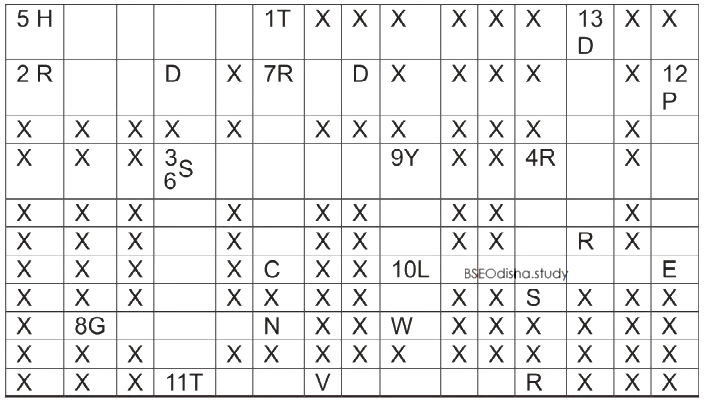
Answer:
| 5H | E | L | M | E | *T | X | X | X | X | X | X | 13D | X | X |
| 2R | O | A | D | X | 7R | E | D | X | X | X | X | R | X | 12P |
| X | X | X | X | X | A | X | X | X | X | X | X | I | X | o |
| X | X | X | 3S | A | F | E | T | 9Y | X | X | 4R | V | X | L |
| X | X | X | E | X | F | X | X | E | X | X | u | E | X | I |
| X | X | X | A | X | I | X | X | L | X | X | L | R | X | c |
| X | X | X | T | X | C | X | X | l0L | I | c | E | N | c | E |
| X | X | X | B | X | X | X | X | O | X | X | s | X | X | X |
| X | 8G | R | E | E | N | X | X | w | X | X | X | X | X | X |
| X | X | X | L | X | X | X | X | X | X | X | X | X | X | X |
| X | X | X | UT | R | A | V | E | L | L | E | R | X | X | X |
Clues :
Down : (Question with Answers)
1. Corning and going of persons and vehicles. ___________
4. We obey them. ________
6. A car driver uses it while driving.__________
9. A colour indicating to ‘proceed with caution’. __________
12. People who control the traffic. ___________
13. A person who drives a vehicle. ___________
Across :
2. A path on which we travel._________
3. Safeness __________
5. We wear it while riding bikes. ______________
7. A colour indicating to ‘stop’. ______________
8. A colour indicating to ‘go’.________________
10. Every driver should have this certificate. ____________
11. A person who goes from one place to another. ____________
Answer:
Down:
1. Traffic
4. Rules
6. Seat-Belt
9. Yellow
12. Police
13. Driver
Across :
2. Road
3. Safety
5. Helmet
7. Red
8. Green
10. Licence
11. Traveller
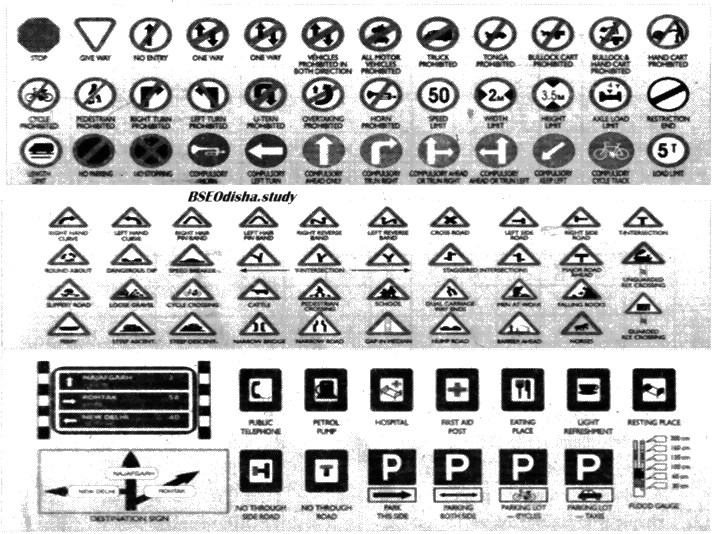
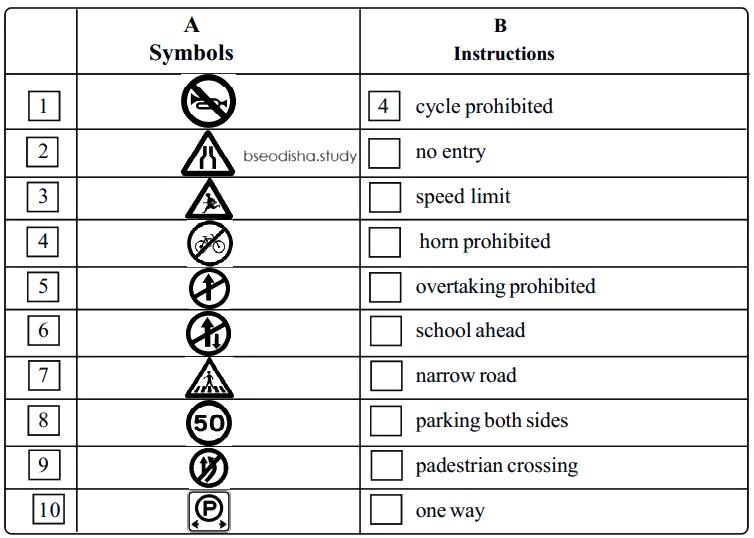
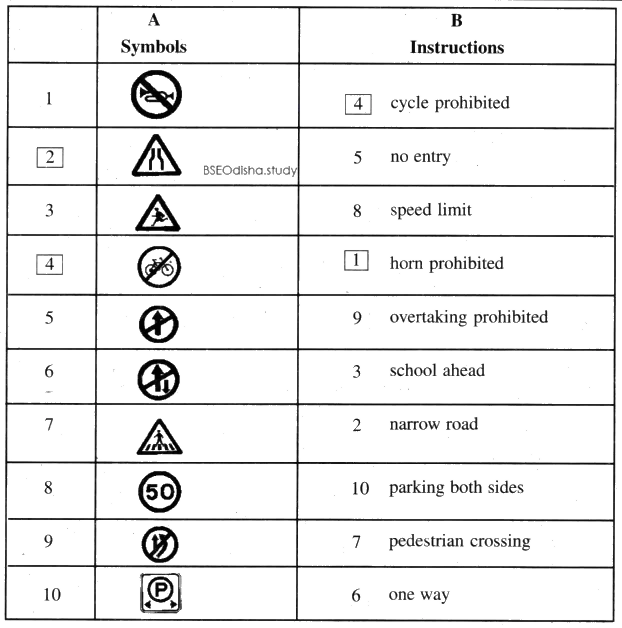
(b) Read and underline the symbols given in the following three charts and match the symbols under ‘A’ with the instructions under ‘B’ in the table below. Write the number of each symbol in the box provided for each instruction. One is done for you. (Question with Answer)
(ନିମ୍ନଲିଖ ତିନୋଟି ଚାର୍ଟରେ ଦିଆଯାଇଥିବା ସଙ୍କେତଗୁଡ଼ିକୁ ପଢ଼ ଓ ରେଖାଙ୍କିତ କର ଏବଂ ନିମ୍ନରେ ଦିଆଯାଇଥିବା ସାରଣୀରେ ସ୍ତମ୍ଭ ‘A’ ତଳେ ଥିବା ସଙ୍କେତକୁ ସ୍ତମ୍ଭ ‘B’ ତଳେ ଥିବା ନିର୍ଦ୍ଦେଶ ସହ ମିଳାଅ । ପ୍ରତ୍ୟେକ ସଙ୍କେତର କ୍ରମସଂଖ୍ୟାକୁ ନିର୍ଦ୍ଦେଶ ପାଇଁ ପ୍ରଦତ୍ତ ବାଢ଼ ମଧ୍ଯରେ ଲେଖ । ଗୋଟିଏ ତୁମ ପାଇଁ କରି ଦିଆଯାଇଛି ।)
(c) Mark the words in bold letters in the following sentences.
(ନିମ୍ନଲିଖ୍ ବାକ୍ୟରେ କଳା ଅକ୍ଷରରେ ଥିବା ଶବ୍ଦଗୁଡ଼ିକୁ ଲକ୍ଷ୍ୟ କର ।)
According to the statistics of the World Health Organisation, most cases of hospitalisation and leading causes of death are due to lack of awareness.
We can break the words in the following way and know how they are formed.
1. hospitalistion = hospitalise + tion
2. organisation = organize + tion
Here ‘hospitalise’ and ‘organise’ are verbs, and ‘hospitalisation’ and ‘organisation’ are nouns.
Now break the following words and find the verbs. You may use a dictionary to get the ‘verb forms’. (Question with Answer).
(ବର୍ତ୍ତମାନ ନିମ୍ନଲିଖ ଶବ୍ଦଗୁଡ଼ିକ ଭାଙ୍ଗି ଦିଅ ଏବଂ କ୍ରିୟାପଦ ବାହାର କର । ତୁମେ ‘କ୍ରିୟା ରୂପ’ ଦେଖିବାପାଇଁ ଅଭିଧାନ ବ୍ୟବାହର କରିପାର । )
| (i) | regulation | = __________ | + ___________ |
| (ii) | celebration | = __________ | + ___________ |
| (iii) | estimation | = __________ | + ___________ |
| (iv) | promotion | = __________ | + ___________ |
| (v) | transportation | = __________ | + ___________ |
| (vi) | observation | = __________ | + ___________ |
| (vii) | education | = __________ | + ___________ |
| (viii) | competition | = __________ | + ___________ |
| (ix) | distribution | = __________ | + ___________ |
| (x) | motivation | = __________ | + ___________ |
| (xi) | commutation | = __________ | + ___________ |
| (xii) | violation | = __________ | + ___________ |
| (xiii) | prevention | = __________ | + ___________ |
| (xiv) | provision | = _________ | + ___________ |
Answer:
| (i) | regulation | = regulate | + tion |
| (ii) | celebration | = celebrate | + tion |
| (iii) | estimation | = estimate | + tion |
| (iv) | promotion | = promote | + tion |
| (v) | transportation | = transport | + tion |
| (vi) | observation | = observe | + tion |
| (vii) | education | = educate | + tion |
| (viii) | competition | = compete | + tion |
| (ix) | distribution | = distribute | + tion |
| (x) | motivation | = motivate | + tion |
| (xi) | commutation | = commutate | + tion |
| (xii) | violation | = violate | + tion |
| (xiii) | prevention | = prevent | + tion |
| (xiv) | provision | = provide | + tion |
Now, fill in the blanks in the following sentences with suitable words (verbs/nouns) from the above list in their correct forms.
(ବର୍ତ୍ତମାନ ନିମ୍ନଲିଖୂ ବାକ୍ୟଗୁଡ଼ିକରେ ଶୂନ୍ୟସ୍ଥାନଗୁଡ଼ିକୁ ଉପରିସ୍ଥ ତାଲିକାରୁ ଉପଯୁକ୍ତ ଶବ୍ଦ (କ୍ରିୟା|ବିଶେଷ୍ୟ) ବାଛି ତା’ର ସଠିକ୍ ରୂପ ବସାଇ ପୂରଣ କର ।)
(i) The government _________ the Road Safety Week every year in the month of January.
(ii) Many non-government __________ provide support to the Road Safety week Campaign.
(iii) The aim of the Road Safety Week Campaign is to _________ the people.
(iv) We can __________ accidents by making people aware of the road safety rules.
(y) Road Safety Quiz ___________ are organised for the young people.
(vi) Persons caught talking or texting on cell phones should be fined not to repeat such ___________.
(vii) The act of coming to the working place and going back home every day is called ____________.
(viii) We can ___________ leaflets to make people aware of the road safety rules.
Answer:
(i) celebrates,
(ii) organisations,
(iii) motivate,
(iv) prevent,
(v) competitions,
(vi) violations,
(vii) commutation,
(viii) distribute
(d) Study the following pairs of words and mark their combination.
(ନିମ୍ନଲିଖତ ଯୋଡ଼ା ଶବ୍ଦଗୁଡ଼ିକୁ ଓ ସେମାନଙ୍କ ସଂଯୋଗ ଲକ୍ଷ୍ୟ କର ।)
- important issue
- educational banners
Here these pairs of words go together and are used in that way. This habitual combination of words sounds natural in English, e.g. : One says ‘strong coffee’ but not ‘powerful coffee’. This combination is called Collocation in English.
In the above examples, the first word is an ‘Adjective’ and the second word is a ‘Noun’. These combination are collocation of nouns and adjectives. We also use ‘Nouns’ with ‘Nouns’ in collocation, e.g.: safety rules.
Now, match the words under ‘A’ with the words under ‘B’ and write the pairs of words below. One is done for you.
(ବର୍ତ୍ତମାନ ‘A’ ସ୍ତମ୍ଭ ତଳେ ଥିବା ଶବ୍ଦଗୁଡ଼ିକୁ ‘B’ ସ୍ତମ୍ଭ ତଳେ ଶବ୍ଦଗୁଡ଼ିକ ସହ ଯୋଗ କରି ଯୋଡ଼ା ଶବ୍ଦ ଗଠନ କର । ତୁମ ପାଇଁ ଗୋଟିଏ କରି ଦିଆଯାଇଛି ।)
| A | B |
| seat | training |
| traffic | driver |
| driving | pedestrians |
| medical | belt |
| parking | rule s |
| probited | area |
| drunken | gap |
| careless | competition |
| distant | check- up |
| drawing | place |
Answer:
| A | B |
| seat | belt |
| traffic | rules |
| driving | training |
| medical | check-up |
| parking | place |
| probited | area |
| drunken | driver |
| careless | pedestrian s |
| distant | gap |
| drawing | competition |
Study the following sentences and mark the highlighted words in bold letters.
(ନିମ୍ନଲିଖ୍ ବାକ୍ୟଗୁଡ଼ିକୁ ଅଧ୍ୟୟନ କର ଏବଂ କଳା ଅକ୍ଷରେ ଦର୍ଶାଯାଇଥିବା ଶବ୍ଦଗୁଡ଼ିକୁ ଲକ୍ଷ୍ୟ କର ।)
1. The driver could not control the bus.
2. You must be careful while crossing the road.
3. We should obey the traffic rules to avoid accidents.
4. The traffic police have to wear uniform.
5. Everyone needs to be well aware of the traffic rules to avoid life risk.
All the highlighted words in the above sentences are ‘Modal Auxiliaries’ that are used with other verbs to express the mood of the speaker/uses.
The “modals” in English language are : can, could, may, might, shall, should, will, would, must, have to , need to, dare, ought to Study the following sentences in the table to know more about the use and meaning of ‘Modals’.
(Modalଗୁଡ଼ିକର ବ୍ୟବହାର ଏବଂ ଅର୍ଥ ଜାଣିବା ପାଇଁ ସାରଣୀରେ ଥିବା ବାକ୍ୟଗୁଡ଼ିକୁ ଅଧ୍ୟୟନ କର ।)
| Modals | Exampels/use in sentences | Meaning |
| can | Sonali can ride a scooty. | ability |
| It can be risky if she rides a motorcycle without knowing traffic rules. | possibility/probability | |
| Can I borrow your helmet? | seeking permission | |
| Can I have a driving licence application form? | request | |
| Can I help you with this luggage? | offering help | |
| Modals | Exampels/use in sentences | Meaning |
| could | Sagarika could read and understand the traffic signs and symbols. | past ability |
| Sushree, could you please tell me the way to the post office? | polite request | |
| Could I ride you bicycle please? | seeking permission | |
| will | The road is very crowded so I will drive my car very carefully. | intention |
| It will be more crowded in the evening. | prediction | |
| I will get you a book about road safety rules. | promise | |
| shall | Shall we hold a meeting to make people aware of the rules? | suggestion |
| Shall I make you the bed? | offering help | |
| would | Would you like to ride a motorbike or drive a car? | preference |
| Would you attend the road safety week campaign? | invitation | |
| Would you mind if I reach half an hour late? | seeking permission | |
| should | We should obey the traffic rules of the road. | obligation |
| may | May I help you? | offering help |
| May I use your helmet? | request | |
| Odisha may become No. 1 state to reduce road accidents by 2020. | prediction | |
| May God bless you! | wish | |
| might | Your life might be unsafe if you do not obey traffic rules. | possibility |
| must | You must listen to your elders. | obligation |
| need to | You need to learn how to drive before you apply for a driving licence. | compulsion |
Now fill in the blanks choosing the appropriate models from brackets.
(ବର୍ତ୍ତମାନ ବନ୍ଧନୀ ମଧ୍ଯରୁ ଉପଯୁକ୍ତ modal from ବାଛି ଶୂନ୍ୟସ୍ଥାନ ପୂରଣ କର ।)
(will, shall, should, can, could, must)
1. This bus take 45 passengers safely.
2. Your driving licence has been approved. You get it next week from the postman.
3. It is your fault. You not drive the car so fast.
4. You ___________ wear a helmet to save your life.
5. He be punished if he does not give up his habit of taking alcohol.
6. you drop me at the station?
7. My father suggests that we be careful while crossing the road.
Answer:
1. can,
2. will,
3. must,
4. should,
5. must,
6. Could,
7. shall
(a) Read the following chart of ‘Road Offences and Penalties’ to write the answer to the questions given below.
( ‘ରାସ୍ତା ନିୟମ ଭଙ୍ଗ ଓ ଜୋରିମାନା’ ଚାର୍ଟଟିକୁ ପଢ଼ ଏବଂ ନିମ୍ନରେ ଦିଆଯାଇଥିବା ପ୍ରଶ୍ନଗୁଡ଼ିକର ଉତ୍ତର ଲେଖ ।)
Road Offences And Penalties
| Offences | Maximum penalty (in rupees) |
| Driving by minor | 500 |
| Driving without helmet | 100 |
| Dangerous or hasty driving | 1000 or imprisonment |
| for six months | |
| Driving without licence | 500 |
| Parking vehicles on footpath | 100 |
| Drunken driving | 2000 |
| Driving unsafe vehicles | Court challenge |
| Using vehicles fitted with dark glasses/sun films | 100 |
| Using horn in silence zone | 100 |
| Parked on pedestrian crossing | 100 |
Question 1. What is the punishment for driving by a minor?
Answer:
He must be fined with Rs. 500/-
Question 2. What is the amount of the fine for driving without a helmet?
Answer:
Rs. 100/- must be fined for driving without a helmet.
Question 3. How much is a person punished for dangerous or hasty driving?
Answer:
He must be fined with Rs. 1000/- or imprisonment for six months.
Question 4. How are the drunken drivers punished?
Answer:
They must be fined with Rs. 2000/-.
Question 5. What happens to a person if he drives a vehicle in unsafe condition?
Answer:
He must be referred for a court challan.
Question 6. What is the fine amount for the vehicles fitted with dark glasses/sun films?
Answer:
The fine amount must be Rs. 100/-.
Question 7. What will happen to you if you park your motorbike on the footpath?
Answer:
I must be fined rupees with Rs. 100/-.
(b) Suppose you are Ashok Kumar, a reporter of ‘The Indian Express’ for your locality. Write a report on an accident you have witnessed, in about 100 words, following the outlines given below.
(ମନେକର ତୁମେ ଅଶୋକ କୁମାର, ତୁମ ଅଞ୍ଚଳ ପାଇଁ “The Indian Express’ର ସାମ୍ବାଦିକ । ତୁମେ ଦେଖୁଥିବା ଏକ ଦୁର୍ଘଟଣାର ବିବରଣୀ ନିମ୍ନଲିଖୂତ ସୂଚନା ଅନୁସାରେ ୧୦୦ଟି ଶବ୍ଦରେ ଲେଖ ।)
(Before writing, fill in the blanks first. You can refer to the text used for lead-in.)
When? (Date and time) :
Where? (Date) :
Who? (Persons/characters present) :
Why? (Causes) :
What? (Results) :
Answer:
(i) The tragic accident happened at 9 p.m. on 20 July, 2019.
(ii) The event happened near Phulnakhara Chhak on the Bhubaneswar Cuttack Road.
(iii) 4 people killed and 15 injured in the accident.
(iv) The driver of the car was attending a call on his mobile phone.
(v) The driver of the bus and about 15 passengers were who were badly injured taken to Capital Hospital and luckily all are out of danger.
Report:
Subject: Road Accident, Three killed
Phulnakhara, Cuttack 20 July 2019 To
The Editor,
The Indian Express, Bhubaneswar
Four people were killed and many others were injured in a road accident near Phulnakhara Chhak at 9 PM on 20th July 2018. A City Ride Bus coming from Cuttack collided with an Indica car coming from Bhubaneswar. The accident took place as the driver of the Indica car was attending a call on his mobile phone. As a result the driver of the car along with three occupants was killed at the spot. The driver of the bus and about fifteen passengers were badly injured. They have been admitted to the Capital Hospital and luckily all are out of danger.
Ashok Kumar Reporter
(c) Suppose you are Ashutosh studying in Class-IX of R.N. High School, Odagoan. Your younger bother, Asmit is studying in Class-Vn, U.G. M.E. School, Adala in Nayagarh. Write a letter, in about 100 words, advising him to obey the road safety rules while riding his bicycle.
(ମନେକର ତୁମେ ଆର୍.ଏନ୍. ହାଇସ୍କୁଲ, ଓଡ଼ଗାଁରେ ନବମ ଶ୍ରେଣୀରେ ପଢ଼ୁଥିବା ଆଶୁତୋଷ । ତୁମ ସାନଭାଇ ଅସ୍ମିତ ନୟାଗଡ଼ର ୟୁ.ଜି.ଏମ୍.ଇ., ଅଦଲାରେ ଅଷ୍ଟମ ଶ୍ରେଣୀରେ ପଢ଼େ । ତାକୁ ସାଇକେଲ ଚଳାଇବାବେଳେ ସଡ଼କ ସୁରକ୍ଷା ନିୟମ ସବୁ ମାନିବାକୁ ଉପଦେଶ ଦେଇ ୧୦୦ଟି ଶବ୍ଦ ମଧ୍ଯରେ ଏକ ପତ୍ର ଲେଖ ।)
Odagoan
2nd July, 2019.
My dear Asmit,
Your letter of 22nd June was to my hands just now. I was happy to know about your school’s reputation in study. Your previous year’s result was extremely well. I hope you will do well this year too. In this letter, I want to say you something about road safety. Dear Asmit, studies should be given top priority. But for that we should take care of body. Always remember safety first. You have to go to school and other places on your bicycle. While riding a bicycle you have to keep in mind the road safety rules. Because if you don’t follow them there are chances of accidents. This may cause injury or cost your precious life. So I want to give you some tips about how to ride bicycle on road safely. While riding a bicycle always keep to your left. Never be unmindful or in hurry. Don’t speed over your bicycle so that you lose your balance and fall down. Always keep you bicycle in good condition.
Hope you must keep my tips in your mind. I have nothing more to pen you.
Yours lovingly
Asutosh
Address
| From Asutosh Mohanty Class- IX Odagoan PIN – _____________ |
To Asmit Mohanty Class -VII U.G.M.E. School, Adala, Nayagarh PIN – _____________ |