9th Class English - Chapter 4 The Missile Man of India All Question With Answer
↓ Question & Answer ↓
Read the text silently and understand. While reading, some new words may stand in your way. Don’t worry. Refer to the ‘Notes and Glossary’ provided at the end of the text. You may also consult a dictionary or your teacher. After you have read, your teacher asks you some questions. Answer them orally.
Question 1. Who was Dr APJ Abdul Kalam?
(ଡ. ଏପିଜେ ଅବଦୁଲ୍ କଲାମ୍ କିଏ ?)
Answer:
Dr. APJ Abdul Kalam was a celebrated scientist and the 11th President of India. He was popularly known as “The Missile Man of India”.
Question 2. Why is Dr Kalam known as “The Missile Man of India”?
(ଡ. କଲାମ୍ ‘ଭାରତର କ୍ଷେପଣାସ୍ତ୍ର ମାନବ’ ଭାବେ କାହିଁକି ପରିଚିତ ?)
Answer:
Dr. Kalam was closely involved in India’s civilian space programme and military missile development efforts. So he is known as “The Missile Man of India”.
Question 3. Where was he born? When?
(ସେ କେଉଁଠାରେ ଜନ୍ମଗ୍ରହଣ କରିଥିଲେ ? କେବେ ?)
Answer:
Dr. Kalam was born in a Tamil Muslim family at Rameswaram in Tamil Nadu on 15 October 1931.
Question 4. Who were his family members?
(କେଉଁମାନେ ତାଙ୍କର ପାରିବାରିକ ସଦସ୍ୟ ଥିଲେ ?)
Answer:
His family members were his father Jainulabdeen, mother Ashima, three elder brothers and an elder sister.
Question 5. Who were his father and mother?
(ତାଙ୍କର ପିତା ଓ ମାତା କିଏ ଥିଲେ ?)
Answer:
His father Jainulabdeen was a boat owner and the Imam of a local mosque. His mother Ashiamma was an ordinary housewife.
Question 6. What was his mother?
(ତାଙ୍କର ମାତା କ’ଣ ଥିଲେ ?)
Answer:
His mother Ashiamma was simply a house-wife and a devotional lady.
Question 7. How did his father earn his living?
(ତାଙ୍କର ପିତା କିଭଳି ଜୀବିକାର୍ଜନ କରୁଥିଲେ ?)
Answer:
His father owned a ferry that took Hindu pilgrims from Rameswaram to Dhanushkodi and back. He earned his living by this small business.
Question 8.Were Kalam’s ancestors rich or poor? How do you know it?
(କଲାମ୍ଙ୍କର ପୂର୍ବପୁରୁଷ ଧନୀ ଅଥବା ଗରିବ ଥିଲେ ? ତୁମେ କିପରି ଏହା ଜାଣୁଛ?)
Answer:
Dr. Kalam’s ancestors were rich traders and land owners. Unluckily in course of time they lost their vast properties even their ancestral house and fell on hard times.
Question 9. How did he add to his family?
(ସେ କିପରି ତାଙ୍କର ପରିବାରକୁ ସହଯୋଗ କରୁଥିଲେ?)
Answer:
In his childhood days he faced misery of life. He had to sell newspapers to supplement his family’s income.
Question 10. What is the third paragraph about?
(ତୃତୀୟ ପାରାଗ୍ରାଫ୍ କେଉଁଥିପାଇଁ ଉଦ୍ଦିଷ୍ଟ?)
Answer:
The third paragraph is about Kalam’s education in his childhood days. It was also dealt with his loving and affectionate science teacher Sivasubramania Iyer.
Question 11. Where did he get his primary education?
(ତାଙ୍କର ପ୍ରାରମ୍ଭିକ ଶିକ୍ଷା କେଉଁଠାରେ ପ୍ରାପ୍ତ ହୋଇଥିଲେ?)
Answer:
Dr. Kalam got his primary education at Ramanathpuram.
Question 12. Who was his science teacher?
(ତାଙ୍କର ବିଜ୍ଞାନ ଶିକ୍ଷକ କିଏ ଥିଲେ ?)
Answer:
Mr. Sivasubramania Iyer was his science teacher when Kalam was in the primary school.
Question 13. What was he like?
(ସେ କିଭଳି ଥିଲେ ?)
Answer:
The science teacher of the school was loving and affectionate to Kalam. As he was a committed teacher, his inspiration made him great.
Question 14. What did he invite Kalam for?
(ସେ କଲାମ୍ଙ୍କୁ କେଉଁଥିପାଇଁ ନିମନ୍ତ୍ରଣ କରିଥିଲେ?)
Answer:
Once he invited Kalam for a meal in his house.
Question 15. How did his wife react to it?
(ଏଥପ୍ରତି ତାଙ୍କ ପତ୍ନୀ କିଭଳି ପ୍ରତିକ୍ରିୟା ପ୍ରକାଶ କରିଥିଲେ?)
Answer:
His wife disliked it and denied serving a Muslim boy like Kalam.
Question 16. What changed her attitude?
(କ’ଣ ତାଙ୍କର ମନୋବୃତ୍ତିରେ ପରିବର୍ତ୍ତନ ଆଣିଥିଲା ?)
Answer:
When the teacher himself served Kalam, his wife was watching behind the kitchen door. But Kalam’s behaviour, way of taking the meal and cleaning the floor changed her attitude.
Question 17. How did she behave him later?
(ପରବର୍ତ୍ତୀ ସମୟରେ ସେ ତାଙ୍କୁ କିଭଳି ବ୍ୟବହାର ଦେଖାଇଥିଲେ?)
Answer:
When the teacher invited Kalam next time, she welcomed him and served him food herself.
Question 18. Who does ‘He’ in the third sentence of para-3 refer to?
(ତୃତୀୟ ଅନୁଚ୍ଛେଦର ତୃତୀୟ ବାକ୍ୟରେ ‘He’ (ସେ) କାହାକୁ ବୁଝାଉଛି ? )
Answer:
‘He’ in third sentence of para-3 refers to Sivasubramania Iyer, Kalam’s science teacher.
Question 19. The fourth paragraph is about his ________.
(ଚତୁର୍ଥ ଅନୁଚ୍ଛେଦଟି ତାଙ୍କ_________ ବିଷୟରେ ।)
A. elementary education
B. higher education
C. secondary education
D. family
(Say the correct answer.)
Answer:
The fourth paragraph is about his secondary education and higher education.
Question 20. Was he good at studies at the high school? Read out the sentence in support of your answer.
(ସେ ଉଚ୍ଚ ବିଦ୍ୟାଳୟରେ ପାଠପଢ଼ାରେ ପାରଦର୍ଶୀ ଥିଲେ କି ? ତୁମ ଉତ୍ତର ସମର୍ଥନରେ ଗୋଟିଏ ବାକ୍ୟ କୁହ ।)
Answer:
Yes, in the line “but was considerd a bright and hard working student” shows that he was good at studies at the high school.
Question 21. What was Kalam’s dream in life?
(ଜୀବନରେ କଲାମଙ୍କର ସ୍ୱପ୍ନ କ’ଣ ଥିଲା)
Answer:
Kalam’s dream in life was to become a pilot.
Question 22. What did he do to fulfil his dream in life?
(ସେ ତାଙ୍କ ଜୀବନର ସ୍ଵପ୍ନକୁ ପୂରଣ କରିବା ପାଇଁ କ’ଣ କଲେ?)
Answer:
In order to fulfill his dream that to become a pilot, he applied for studying engineering at the Madras Institute of Technology.
Question 23. Do you have any dream? How can you fulfil your dream in your life?
(ତୁମ ମନରେ କିଛି ସ୍ବପ୍ନ ଅଛି କି ? ତୁମେ ତାକୁ କିଭଳି ପୂରଣ କରିପାରିବ ?)
Answer:
Yes, like others, I have a dream to become an engineer. I am studying hard to fulfil my dream in life.
Question 24. What problem did he face for his admission into engineering?
(ଇଞ୍ଜିନିୟରିଂ ପଢ଼ିବ ପାଇଁ ସେ କେଉଁ ସମସ୍ୟାର ସମ୍ମୁଖୀନ ହୋଇଥିଲେ ?)
Answer:
It was not so easy to take admission at such a prestigious institution like Madras Institute of Technology. It was an expensive affair. The problem that he faced for his admission into engineering was that he didn’t have one thousand rupees to pay towards his course fee.
Question 25. Who came to his help? How?
(କିଏ ତାଙ୍କୁ ସାହାଯ୍ୟ କଲା? କିପରି?)
Answer:
Asim Zohra, his loving elder sister came to his help. She mortgaged her gold ornaments for his admission fee.
Question 26. When did he complete his aerospace engineering?
(ସେ କେବେ ଅନ୍ତରୀକ୍ଷ ଇଞ୍ଜିନିୟରିଂ ପଢ଼ା ଶେଷ କଲେ ?)
Answer:
He completed his aerospace engineering in 1960.
Question 27.
Name the institution where he got –
(ଶିକ୍ଷାନୁଷ୍ଠାନର ନାମ ଲେଖ ଯେଉଁଠାରେ ସେ -)
(a) Secondary Education:
(b) Graduation in Physics:
(c) Aerospace Engineering:
Answer:
(a) He got secondary education at the Schwartz Higher Secondary School.
(b) He got graduation in Physics at, Saint Joseph’s College, Tiruchirapalli.
(c) He got Aerospace Engineering at the Madras Institute of Technology.
Question 28.
The pragraphs- 5 and 6 describe Dr. Kalam’s career as ________.
(ପଞ୍ଚମ ଓ ଷଷ୍ଠ ଅନୁଚ୍ଛେଦରେ କଲାମଙ୍କର ବୃତ୍ତି ଜଣେ __________ ଭାବରେ ବର୍ଣ୍ଣନା କରାଯାଇଛି ।)
a marine engineer
an aerospace scientist
a plant scientist
a software engineer
Answer:
The paragraph 5 and 6 describe Dr. Kalam’s career as an aerospace scientist.
Question 29. How did he begin his career?
(ସେ ତାଙ୍କର ବୃତ୍ତି କିଭଳି ସେ ଆରମ୍ଭ କଲେ ?)
Answer:
Kalam began his career as a trainee at Hindustan Aeronautics Limited in Bangalore.
Question 30.
Where was he appointed as a scientist first?
(ଜଣେ ବୈଜ୍ଞାନିକ ଭାବରେ କେଉଁଠାରେ ସେ ପ୍ରଥମେ ନିଯୁକ୍ତି ପାଇଲେ?)
Answer:
He was appointed as a scientist first at the Defence Research Development Organisation (DRDO).
Question 31.
When did he start his work in the Indian Space Research Organisation?
(ଭାରତୀୟ ଅନ୍ତରୀକ୍ଷ ଗବେଷଣା ପ୍ରତିଷ୍ଠାନରେ ସେ କେବେ ତାଙ୍କର କାର୍ଯ୍ୟ ଆରମ୍ଭ କଲେ?)
Answer:
He started his work in the Indian Space Research Organisation in 1969.
Question 32.
What was the purpose of the satellite?
(ଉପଗ୍ରହର ଉଦ୍ଦେଶ୍ୟ କ’ଣ ଥିଲା?)
Answer:
The purpose of satellite was to develop the technology to launch the satellite into the orbit.
Question 33.
When was the first Rohini satellite launched into the orbit?
(ପ୍ରଥମ ରୋହିଣୀ ଉପଗ୍ରହକୁ କେବେ କକ୍ଷପଥରେ ଅବସ୍ଥାପିତ କରାଗଲା?)
Answer:
The first Rohini satellite launched into the orbit in 1980.
Question 34.
How many years did Kalam spend in the ISRO?
(ଇସ୍ରୋରେ କଲାମ୍ କେତେ ବର୍ଷ ବିତାଇଥିଲେ?)
Answer:
Kalam spent nineteen years in the ISRO.
Question 35.
Where did he take the leading role in the development of India’s missiles and nuclear weapons programme?
(ସେ କେଉଁଠାରେ ଭାରତର କ୍ଷେପଣାସ୍ତ୍ର ଓ ପରମାଣୁ ଅସ୍ତ୍ରଶସ୍ତ୍ର କାର୍ଯ୍ୟକ୍ରମର ବିକାଶ ନିମନ୍ତେ ମୁଖ୍ୟ ଭୂମିକା ନିର୍ବାହ କରିଥିଲେ?)
Answer:
Kalam took the leading role in the development of India’s missiles and nuclear weapons programme at the DRDO.
Question 36.
What made him extremely popular in the country?
(ସେ କେଉଁଥପାଇଁ ଦେଶର ଅତୀବ ଲୋକପ୍ରିୟ ହୋଇଥିଲେ?)
Answer:
Under his guidance and supervision the development of India’s missiles and nuclear
weapons programme became very successful and led to the development of four missiles namely Prithi, Trishul, Akash and Nag. This made him extremely popular in the country.
Question 37.
What was he called after the success of the four missiles- Prithvi, Trishul, Akash and Nag?
(ପୃଥବୀ, ତ୍ରିଶୂଳ, ଆକାଶ ଓ ନାଗ୍ – ଏହି ଚାରୋଟି କ୍ଷେପଣାସ୍ତ୍ର ସଫଳତା ପରେ, ତାଙ୍କୁ କ’ଣ କୁହାଗଲା?)
Answer:
After the success of the four missiles- Prithvi, Trishul, Akash and Nag, he was popularly called as “The Missile Man of India”
Question 38.
Why did he camp in Rajasthan’s Thar Desert?
(ରାଜସ୍ଥାନର ଥର୍ ମରୁଭୂମିରେ ସେ କାହିଁକି ଅସ୍ଥାୟୀ ଭାବେ ରହିଥିଲେ ?)
Answer:
Kalam camped in Rajasthan’s Thar Desert to supervise the Pokhran-II, nuclear tests.
Question 39.
What, according to Dr Kalam, was the “defining moment” in the history of our country?
(ଡ. କଲାମ୍ଙ୍କ ଅନୁସାରେ, ଭାରତ ଇତିହାସରେ ଘଡ଼ିସନ୍ଧି ମୁହୂର୍ଭ କେଉଁଟି ଥିଲା ?)
Answer:
According to Dr Kalam, his stay in Rajasthan’s Thar Desert for a fortnight to supervise the Pokharan-II nuclear tests was the defining moment in the history of our country.
Question 40.
Why was it very hard to camp in Rajasthan’s Thar Desert?
(ରାଜସ୍ଥାନର ଥର୍ ମରୁଭୂମିରେ ଅସ୍ଥାୟୀ ଭାବେ ଅବସ୍ଥାନ କରିବା କାହିଁକି କଠିନ ଥୁଲା ?)
Answer:
It was very hard to camp in Rajasthan’s Thar Desert because these were the hot days of 1998 at Pokhran. On a particular day the temperature there rose to 53° C.
Question 41.
What are Kalam’s contributions for India’s defence programme?
(ଭାରତର ପ୍ରତିରକ୍ଷା କାର୍ଯ୍ୟକ୍ରମକୁ କଲାମ୍ର ଦାନ କ’ଣ ଥିଲା ?)
Answer:
Kalam’s contribution for India’s defence programme is great. He had developed a number of missiles and nuclear weapons for the sake of country’s defence.
Question 42.
Dr. Kalam was the Chief Scientific Advisor to _______ of India.
(ଡ. କଲାମ୍ ଭାରତର ___________ ଙ୍କ ମୁଖ୍ୟ ବିଜ୍ଞାନ ବିଷୟକ ପରାମର୍ଶଦାତା ଥିଲେ ।)
i. the President
iii. the Field Marshal
ii. the Prime Minister
iv. the Secretary of Defence
(Choose the correct answer.)
Answer:
Dr. Kalam was the Chief Scientific Advisor to the Prime Minister of India.
Question 43.
What awards and honours was Kalam honoured with?
(କଲାମ୍ଙ୍କୁ କେଉଁ ସମ୍ମାନଗୁଡ଼ିକରେ ସମ୍ମାନିତ ହୋଇଥିଲେ ?)
Answer:
Dr. Kalam was honoured with the Padma Bhushan in 1981, the Padma Vibhusan in 1990 and the nation’s highest civilian honour, The Bharat Ratna in 1997.
Question 44.
What is the highest civilian award of our country?
(ଭାରତର ସର୍ବଶ୍ରେଷ୍ଠ ବେସାମରିକ ସମ୍ମାନ କ’ଣ ଅଟେ?)
Answer:
The highest civilian award of our country is ‘the Bharat Ratna’.
Question 45.
How did Kalam pass away?
(କଲାମ୍ କିପରି ଶେଷ ନିଶ୍ଵାସ ତ୍ୟାଗ କଲେ?)
Answer:
On 27th July 2015 Dr. Kalam was delivering a lecture in Shillong. During the course of his lecture, he collapsed and was immediately taken to the hospital. There he passed away from us in a massive cardiac arrest.
Question 46.
Why will people of our country remember Kalam forever?
(ଆମ ଦେଶର ଲୋକମାନେ କଲାମ୍ଙ୍କୁ କାହିଁକି ମନେ ରଖୁବେ?)
Answer:
The people of our country will remember Kalam for his dedication, devotion and selfless service to the nation, particularly as ‘The Missile Man of India’.
Question 47.
What qualities of Dr Kalam do you like very much?
(କଲାମ୍ଙ୍କର କେଉଁ ଗୁଣଗୁଡ଼ିକ ତୁମକୁ ବେଶି ଭଲ ଲାଗୁଛି ?)
Answer:
Dr. Kalam was qualitative man. His simple living, ideal life, great devotion and dedication and service to the nation make him popular in the country.
Question 48.
Can you say the names of some eminent scientists who have contributed a lot to our country?
(ଯେଉଁ ପ୍ରଖ୍ୟାତ ବୈଜ୍ଞାନିକମାନେ ଦେଶ ପାଇଁ ଅନେକ ଅବଦାନ ଦେଇଯାଇଛି ତୁମେ ସେମାନଙ୍କ ମଧ୍ୟରୁ କେତେକଙ୍କ ନାମ କହିପାରିବ କି?)
Answer:
C.V. Raman, Homi J. Bhabha, Visvesvaraya and Vikram Sarabhai are some of the eminent great scientists of our country. They have contributed a lot for our country.
(a) Match the paragraph numbers under column- ‘A’ with their main ideas given under column-‘B\ Write the paragraph number in the box given against each idea. (Question with Answer)
(‘A’ ସ୍ତମ୍ଭ ତଳେ ଥିବା ଅନୁଚ୍ଛେଦ କ୍ରମ ସଂଖ୍ୟା ସହ ‘B’ ସ୍ତମ୍ଭ ତଳେ ଥିବା ମୁଖ୍ୟ ବିଷୟବସ୍ତୁ ମିଳାଅ । ଅନୁଚ୍ଛେଦ କ୍ରମ ସଂଖ୍ୟାକୁ ପ୍ରଦତ୍ତ ବାକ୍ସ ଭିତରେ ଲେଖ । ଗୋଟିଏ ତୁମ ପାଇଁ କରିଦିଆଯାଇଛି ।)
| A (Paragraph Numbers) |
B Main Ideas |
| 1 | [ ] Elementary education |
| 2 | [ ] Death of Kalam |
| 3 | [ ] Awards and honours |
| 4 | [ ] Introducing Dr APJ Abdul Kalam |
| 5, 6 and 7 | [ ] Secondary and higher education |
| 8 | [ ] Kalam’s childhood |
| 9 | [ ] Career and contribution |
Answer:
| A (Paragraph Numbers) |
B Main Ideas |
| 1 | 3 Elementary education |
| 2 | 9 Death of Kalam |
| 3 | 8 Awards and honours |
| 4 | 1 Introducing Dr APJ Abdul Kalam |
| 5, 6 and 7 | 4 Secondary and higher education |
| 8 | 2 Kalam’s childhood |
| 9 | 5, 6 and 7 Career and contribution |
(b) Fill in the blanks choosing the right answers from brackets.
(ବନ୍ଧନୀ ମଧ୍ଯରେ ସଠିକ୍ ଉତ୍ତର ବାଛି ଶୂନ୍ୟସ୍ଥାନ ପୂରଣ କର ।)
[elementary education, his science teacher, the People’s President, his family income, Chief Scientific Advisor, The Bharat Ratna, development of four missiles, Integrated Missile Development Programme]
(i) Dr APJ Abdul Kalam is popularly known as ________.
(ii) Kalam has to sell newspapers to supplement ________.
(iii) Kalam started his ______ at Ramanathapuram.
(iv) Kalam’s most favourite teacher was ________.
(v) Dr Kalam was popularly called ‘The Missile Man of India’ after the success of the _________.
(vi) The successful launch of the missiles was possible when Kalam was heading the ________.
(vii) Dr APJ Abdul Kalam was honoured the nation’s highest honour ________ in 1997.
(viii) Dr Kalam was the________ to the Prime Minister and the Secretary of Defence Research and Development Organisation.
Answer:
(i) Dr APJ Abdul Kalam is popularly known as people’s President.
(ii) Kalam has to sell newspapers to supplement his family income.
(iii) Kalam started his elementary education at Ramanathapuram.
(iv) Kalam’s most favourite teacher was his science teacher.
(v) Dr Kalam was popularly called ‘The Missile Man of India’ after the success of the development of four missiles.
(vi) The successful launch of the missiles was possible when Kalam was heading the Integrated Missile Development Programme.
(vii) Dr APJ Abdul Kalam was honoured the nation’s highest honour the Bharat Ratna in 1997.
(viii) Dr Kalam was the Chief Scientific Advisor to the Prime Minister and the Secretary of Defence Research and Development Organisation.
(c) Read the text and find out the situations :
(ପାଠ୍ୟବିଷୟକୁ ପଢ଼ ଏବଂ ପରିସ୍ଥିତିକୁ ଖୋଜି ବାହାର କର ।)
(i) when Kalam faced challenges on his way to achievements
Answer:
Kalam faced challenges on his way to achievements at the time of taking admission in the Madras Institute of Technology.
(ii) when Kalam felt happy –
Answer:
Kalam faced challenges on his way to achievements at the time of taking admission in the Madras Institute of Technology.
(a) Listen to each of the following expressions and say the line(s) and paragraph number in which it occurs. (Question with Answer)
(ତଳଲିଖ ଉକ୍ତିଗୁଡ଼ିକୁ ଶୁଣ ଏବଂ ଧାଡ଼ି ଏବଂ ଅନୁଚ୍ଛେଦ କ୍ରମ ସଂଖ୍ୟା କୁହ ।)
Question 1.
Kalam as the 11th President of India
Answer:
In 2002, he was elected as the 11th President of India, and was widely referred to as the “People’s President”. (Line – 3, Paragraph – 1)
Question 2.
Date and place of birth of Kalam
Answer:
Dr. Abdul Kalam was born on 15th October 1931 in a Tamil Muslim family at Rameswaram in the state of Tamil Nadu. (Line – 1, Paragraph – 2)
Question 3.
Kalam’s elementary education
Answer:
Kalam started his elementary education at Ramanathapuram. (Line – 3, Paragraph – 3)
Question 4.
The Schwartz Higher Secondary School
Answer:
Kalam then moved to the Schwartz Higher Secondary School for his secondary education. (Line – 1, Paragraph – 4)
Question 5.
He graduated in Physics
Answer:
After completing his studies here, Kalam was admitted to Saint Joseph’s College, Tiruchirappalli where he graduated in Physics in 1954. (Line – 4, Paragraph – 4)
Question 6.
Zohra, his sister helped Kalam for his education
Answer:
Asim Zohra, his compassionate elder sister, came to his help. (Line – 10, Paragraph – 4)
Question 7.
He completed aerospace engineering in 1960.
Answer:
And he completed his aerospace engineering in 1960. (Line – 12, Paragraph – 4)
Question 8.
Joined DRDO
Answer:
Then he joined the Defence Research Development Organisation (DRDO) as a scientist. (Line – 2, Paragraph – 5)
Question 9.
Kalam succeeded in launching the first satellite, Rohini.
Answer:
It was under Dr Kalam’s direct guidance and supervision that the first Rohini satellite was successfully launched into the orbit in 1980. (Line – 5, Paragraph – 5)
(b) Say the full forms of the following acronyms/abbreviations in a chain-drill, (one after another)
(ନିମ୍ନଲିଖ ସଂକ୍ଷିପ୍ତ ରୂପଗୁଡ଼ିକର ପୂର୍ବରୂପ କ୍ରମାନୁସାରେ କୁହ ।) (ଗୋଟିକ ପରେ ଗୋଟିଏ)
(i) HAL: Hindustan Aeronautics Limited
(ii) DRDO: Defence Research Development Orgnisation.
(iii) ISRO: Indian Space Research Organisation
(iv) SLV: Satellite Launch Vehicle
(v) IGMDP: Integrated Missile Development Programme
(a) Match the words under ‘A’ with their opposite meanings under ‘B’. One is done for you.
(ସ୍ତମ୍ଭ ‘A’ ତଳେ ଥିବା ଶବ୍ଦଗୁଡ଼ିକୁ ସ୍ତମ୍ଭ ‘B’ ତଳେ ଥିବା ଶବ୍ଦ ସହ ମିଳାଅ । ଗୋଟିଏ ତୁମ ପାଇଁ କରି ଦିଆଯାଇଛି ।)
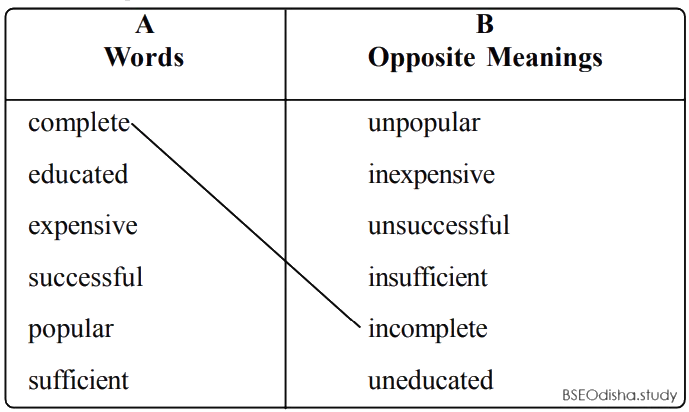
Answer:
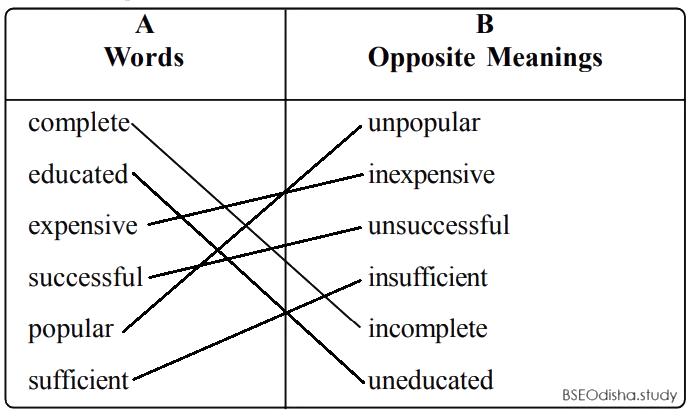
(b) Match the words/phrases under ‘A’ with their meanings tinder ‘B\ Write the number of the word in the box for each. (Question with Answer)
(‘A’ ତଳେ ଥିବା ଶବ୍ଦଗୁଡ଼ିକୁ ‘B’ ତଳେ ଥିବା ସେଗୁଡ଼ିକର ଅର୍ଥ ସହ ମିଳାଅ । ପ୍ରତ୍ୟେକ ଶବ୍ଦର କ୍ରମ ସଂଖ୍ୟା ବାକ୍ସ ମଧ୍ୟରେ ଲେଖ ।)
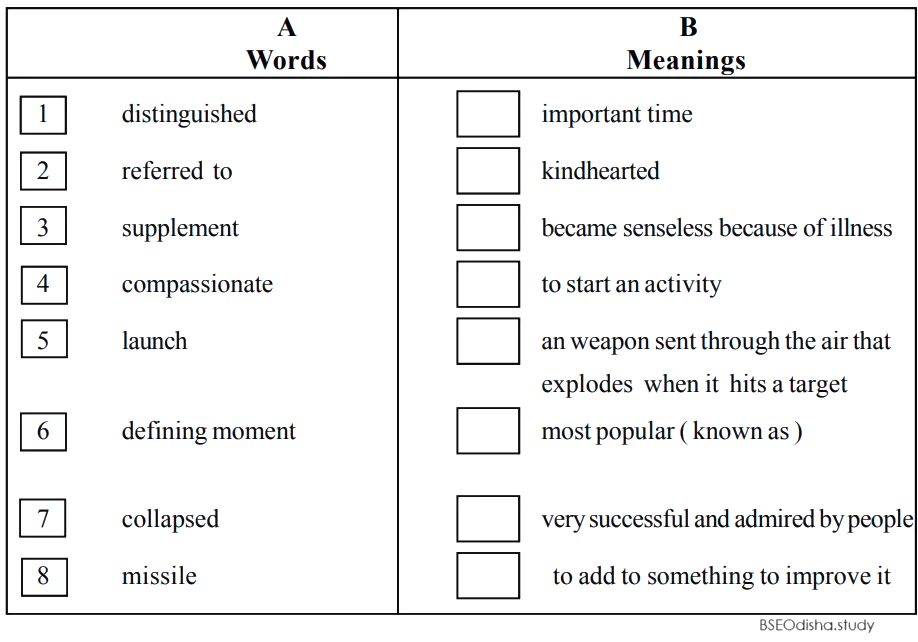
Answer:
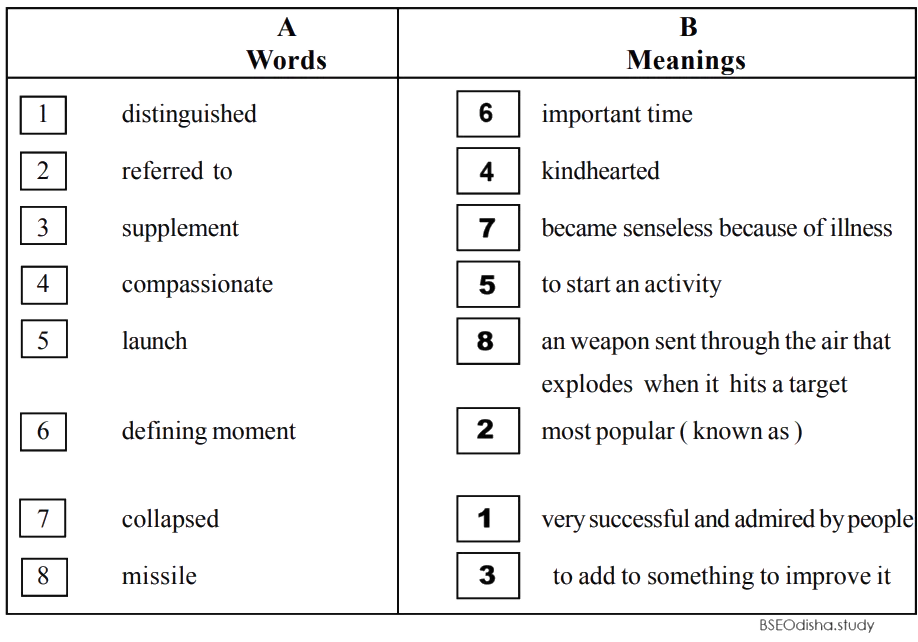
(c) Read the following sentence and mark the word in bold letters.
His mother, Ashiamma was a housewife.
Here the word- housewife in the above sentence is built with two words: house + wife.
This is a compound word.
(i) Given below are some compound words. Break them as done above. (Question with answer)
(ତଳେ କେତେକ ଯୌଗିକ ଶବ୍ଦ ଦିଆଯାଇଛି । ଉପରେ କରାଯାଇଥିବା ଭଳି ସେଗୁଡ଼ିକୁ ଅଲଗା ଅଲଗା କର ।)
(ii) Will you write ten more compound words on your own?
(ତୁମେ ନିଜେ ଆଉ ଦଶଟି ଶବ୍ଦ ଲେଖୁରିବ କି ?)
| landowner | = | land | + | owner |
| weekend | = | week | + | end |
| milestone | = | mile | + | stone |
| headline | = | head | + | line |
| newspaper | = | news | + | paper |
| overtime | = | over | + | time |
| childhood | = | child | + | hood |
(ii) Will you write ten more compound words on your own? (ତୁମେ ନିଜେ ଆଉ ଦଶଟି ଶବ୍ଦ ଲେଖୁରିବ କି ?)
Answer:
| airbase | = | air | + | base |
| shorthand | = | short | + | hand |
| lowland | = | low | + | land |
| headword | = | head | + | word |
| washerman | = | washer | + | man |
| heatwave | = | heat | + | wave |
| downstream | = | down | + | stream |
| airbag | = | air | + | bag |
| wasteland | = | waste | + | land |
| grandparents | = | grand | + | parents |
(a) Study the following sentence and mark the words in bold letters.
Dr APJ Abdul Kalam was bom on 15 October 1931.
We use the past form of the ‘be’ verb – was/were + born (the third form of the verb ‘bear’) to talk about the event of birth of a person.
Work in pairs, discuss and fill in the blanks in the table. Then write the sentence below the table. One is done for you. (Question with Answer)
(ଯୋଡ଼ି ହୋଇ ଆଲୋଚନା କର ଏବଂ ସାରଣୀରେ ଥିବା ଶୂନ୍ୟସ୍ଥାନ ପୂରଣ କର । ତା’ପରେ ବାକ୍ୟଟିକୁ ସାରଣୀ ତଳେ ଲେଖ । ଗୋଟିଏ ତୁମ ପାଇଁ କରି ଦିଆଯାଇଛି ।)
| Name of the person | Place of Birth | Date of Birth |
| Mahatma Gandhi | Porbandar, Gujrat | 2nd October 1869 |
| Dr. Sarvepalli Radhakrishnan | Tiruttani, Madras | 5th September 1888 |
| Gopabandhu Dash | Suando, Puri, Odisha | 9th October 1877 |
| Madhusudan Das | Satyabhamapur, Cuttack Odisha, | 28th April 1848 |
| Biju Patnaik | G.Nuagan, Bellaguntha, Ganjam, Odisha | 5th March 1916 |
| Jagadish Chandra Bose | Memvnesinsh in Bengal | 30 November 1858 |
1. Jagadish Chandra Bose was born at Memynesingh in Bengal on 30 November 1858.
2. Mahatma Gandhi was bom at Porbandar, Gujrat on 2nd October 1869
3. Dr. Sarvepalli Radhakrishnan was born at Tiruttani, Madras on 5th September 1888
4. Gopabandhu Dash was bom at Suando, Puri, Odisha on 9th October 1877
5. Madhusudan Das was bom at Satyabhamapur, Cuttack, Odisha on 28th April, 1848 . 6. Biju Pattanik was bom at G. Nuagan, Bellaguntha, Ganjam, Odisha on 5th March 1916.
(b) Read the following sentences carefully and mark the verbs in bold letters.
1. Kalam was the youngest of four brothers and one sister in his family.
2. Mathematics was his favourite subject.
3. Around a thousand rupees was required to pay towards the course fee.
4. Bundles of newspapers were distributed by Kalam.
Here the verb ‘was’ agrees with the subjects of the sentence from l to 3; Kalam, Mathematics, a thousand rupees, and the verb ‘were’ in the sentence – 4 agrees with the subject ‘Bundles of newspapers’.
Let us now know more about ‘Subject and Verb Agreement’.
Nouns like news, physics, mathematics, measles and ethics look like plural in form but they are singular and take singular verbs.
Uncountable nouns like furniture, equipment, stationery, luggage, weather, advice and information are singular and used with singular verbs.
Nouns like compasses, glasses, goods, trousers, police, people, etc. take plural verbs
Fill in the blanks with the correct verb choosing from brackets given against each.
(ପ୍ରତ୍ୟେକର ପାର୍ଶ୍ଵରେ ଥିବା ବନ୍ଧନୀ ମଧ୍ଯରୁ ସଠିକ୍ କ୍ରିୟାପଦ ବାଛି ଶୂନ୍ୟସ୍ଥାନ ପୂରଣ କର ।)
(i) Gymnastics ______ sport, (is/are)
(ii) Social Studies _______ my favourite subject, (is/are)
(iii) Politics ______here and now. (is/are)
(iv) The news _______been published in the local daily. (has/have)
(v) The police ________ the traffic. (control/controls)
(vi) A hundred kilometres ________ a long distance. (is/are)
(vii) Measles ______ fever. (cause/causes)
Answer:
i) is
ii) is
iii) is
vi) has
v) control
vi) is
vii) causes
(a) Given below are some important events from the text. They are not in order. Arrange them in order and put the serial number in the box for each. Write the sentences.
( ନିମ୍ନରେ ପାଠ୍ୟବିଷୟର କେତେକ ପ୍ରଧାନ ଘଟଣା ଦିଆଯାଇଛି । ସେଗୁଡ଼ିକ କ୍ରମରେ ନାହାନ୍ତି । ସେଗୁଡ଼ିକୁ କ୍ରମାନୁସାରେ ସଜାଅ ଓ ପ୍ରତ୍ୟେକଟି ପାଇଁ ବାକ୍ସ ମଧ୍ୟରେ କ୍ରମସଂଖ୍ୟା ଲେଖ । ବାକ୍ୟଗୁଡ଼ିକୁ ଲେଖ ।)
(i) He graduated in Physics from Saint Joseph’s College, Tiruchirappalli. [4]
(ii) He played a pivotal role in the Pokhran-II nuclear test project. [5]
(iii) Abdul Kalam was born to a Tamil Muslim family in the pilgrimage centre of Rameswaram. [1]
(iv) He got his elementary education at Ramanathapuram. [2]
(v) He went to Schwartz Higher Secondary School for his secondary education. [3]
(vi) He became the Head of the Integrated Missile Development Programme and succeeded in launching Prithvi missile. [5]
(vii) He breathed his last on July, 27, 201 5. [8]
(viii) He became the Chief Scientific Advisor to the Prime Minister of India in 1992. [7]
Answer:
(iii) Abdul Kalam was born to a Tamil Muslim family in the pilgrimage centre of Rameswaram. [1]
(iv) He got his elementary education at Ramanathapuram. [2]
(v) He went to Schwartz Higher Secondary School for his secondary education. [3]
(i) He graduated in Physics from Saint Joseph’s College, Tiruchirappalli. [4]
(vi) He became the Head of the Integrated Missile Development Programme and succeeded in launching Prithvi missile. [5]
(ii) He played a pivotal role in the Pokhran-II nuclear test project. [6]
(viii) He became the Chief Scientific Advisor to the Prime Minister of India in 1992. [7]
(vii) He breathed his last on July 27, 2015. [8]
(b) Read the text and fill in the bio-data of Dr Kalam given below.
(ପାଠ୍ୟବିଷୟକୁ ପଢ଼ ଓ ନିମ୍ନରେ ଥିବା କଲାମ୍ଙ୍କ ଆତ୍ମ ବିବରଣୀ ପତ୍ରର ଶୂନ୍ୟସ୍ଥାନ ପୂରଣ କର ।)
| Bio-Data | ||
| Name in full | : | |
| Father’s name | : | |
| Mother’s name | : | |
| Place of birth | : | |
| Date of birth | : | |
| Brothers and sister | : | |
| Nationality | : | |
| Religion | : | |
| Education | : | |
| Profession | : | |
| Important post held | : | |
| Achievements | : | |
| Awards/honours | : | |
| Life style | : | |
| Date of passing away | : |
Answer:
| Bio-Data | ||
| Name in full | : | Avul Pakir Jainulabdeen Abdul Kalam |
| Father’s name | : | Jainulabdeen |
| Mother’s name | : | Ashiamma |
| Place of birth | : | Rameswaram in the state of Tamil Nadu |
| Date of birth | : | 15th October 1931 |
| Brothers and sister | : | They are four brothers and one sister |
| Nationality | : | Indian |
| Religion | : | Muslim |
| Education | : | graduate in Physics, aerospace engineering etc. |
| Profession | : | Aerospace scientist |
| Important post held | : | Chief Scientific Advisor to the Prime Minister and the Secretary of DRDO |
| Achievements | : | Successfully develop four missiles as the head of IGMDP |
| Awards/honours | : | the Padma Bhushan in 1981, the Padma Vibhushan in 1990 and the Bharat Ratna in 1997. |
| Life style | : | very simple, dedicated and devotional |
| Date of passing away | : | 27th Ju1y 20l5 |
(c) Use the facts/information you gathered in the Bio-data Form above and write a composition on Dr Kalam.
(ଉପରିସ୍ଥ କଲାମ୍ଙ୍କ ଆତ୍ମ ବିବରଣୀପତ୍ରରେ ତୁମେ ଏକତ୍ର କରିଥିବା ତଥ୍ୟଗୁଡ଼ିକୁ ବ୍ୟବହାର କରି ଏକ ଅନୁଚ୍ଛେଦ ଲେଖ ।)
Answer:
Dr. APJ Abdul Kalam was a celebrated scientist of India. His father was Jainulabdeen and mother was Ashiamma. He was born on 15th October 1931 at Rameswaram in the state of Tamil Nadu. He had three brothers and one sister. He was Muslim in religion and he was an Indian. He was graduated in Physics and completed aerospace engineering. He worked as a scientist in DRDO and ISRO. He was appointed as the Chief Scientific Adviser to the Prime Minister and the Secretary of DRDO. He was awarded with the Padma Bhusan in 1981, the Padma Vibhusan in 1990 and the Bharat Ratna in 1997. This missile man departed from us on 27th July 2015.
(d) Refer to the text and fill in the blanks in the following table with correct information wherever possible. Then write a paragraph about the events/achievements of Dr APJ Abdul Kalam. (Question with Answer)
(ପାଠ୍ୟବିଷୟକୁ ଆଧାର କରି ଯଥାସମ୍ଭବ ସଠିକ୍ ତଥ୍ୟଦ୍ୱାରା ଶୂନ୍ୟସ୍ଥାନ ପୂରଣ କର । ତା’ପରେ ଡ. ଏପିଜେ ଅବ୍ଦୁଲ୍ କଲାମ୍ଙ୍କ ସମ୍ପର୍କିତ ଘଟଣା/କୃତି ବିଷୟରେ ଏକ ପ୍ରବନ୍ଧ ଲେଖ ।)
| Events/activities | Place | Year of happening |
| Birth | Rameswaram in the state of Tamil Nadu | 15th October 1931 |
| Completed aerospace engineering | Madras Institute of Technology | 1960 |
| Began career as a trainee | Hindustan Aeronautics Limited | |
| Joined as a scientist | Defence Research Development Organisation | |
| Project Director, ISRO | ISRO | 1969 |
| Launching of Rohini satellite | ISRO | 1980 |
| Headed the IGMDP | DRDO | |
| Supervised Pokhran-II nuclear tests | Rajasthan’s Thar Desert | 1998 |
| Scientist of DRDO | DRDO | 1998 |
| President | India | 2002 |
| Death | Shillong | 27th July 2015 |
Paragraph :
Dr. APJ Abdul Kalam was born at Rameswaram in the state of Tamil Nadu. He studies at the Madras Institute of Technology and completed aerospace engineering in 1960. He began his career as a trainee at Hindustan Aeronautics Limited. Then he joined the Defence Research Development Organisation as a scientist. In 1969, he was transferred to ISRO, where he worked as the Project Director of SLV-III.
There under his direct guidance and supervision the first Rohini satellite was successfully launched into the orbit in 1980. Then he returned to the DRDO and headed the IGMDR. In 1998, he supervised the Pokhran-H nuclear test in Rajasthan’s Thar Desert. He was a scientist at the DRDO in 1998. He was elected as the President of India in 2002. On 27th July 2015, while he was delivering a lecture at Shillong suffered a massive cardiac arrest and was taken to the hospital and passed away there.